
ERASURE Squared²
Raising Erasure to the power of two, the process of multiplying Erasure by itself.
It is brand-new artwork to replace the art that I curated and produced on the same box, which was vandalised by hate, shortly after the original installation in late 2021.
I had designed two sides on the same box as seth cardinal dodginghorse (Tsuut’ina Nation)--we created artwork that shared a single utility box. I want to foster truth & reconciliation and replace the photographs of whites-only on the Canton Block utility box, to include Indigenous Peoples. What ensued was that the newly installed artwork was intentionally scratched out in a deeply hateful way, both literally and in every way.
Here's the IG post where seth talked about the artwork and the hate vandalism.
How do we respond to and advance the Truth and Reconciliation Commission's 94 “Calls to Action,” when we are erased and displaced, from our community living room? We are all Treaty people.
It is pure irony that the original artwork to address erasure and displacement has been “erased.” The box measures 30 in x 17 in = 510 in². Though it may only be covering an area of 3.5 ft²—we are standing our ground.
Original artwork panels shared historical photos from the Glenbow collection along with written content, and the layout was created in consultation with Keyan Zhang, an accomplished publishing designer/calligrapher (Chinese ink brush) who is engaged again for the new artwork.
Here’s a clip from the 2021 press release:
In November 2021, Fung Ling Feimo had installed artwork on the utility box located at the northeast corner of the historic Canton Block. The project addresses the erasure of local histories and seeks to explore the social intersections and cultural intersectionalities that make up Calgary. The project seeks to replace existing images on the Canton Block utility box to reflect rather than erase the BIPOC who were/are here.
As an arts enthusiast, Ms. Feimo is passionate about arts and culture. She states:
“To know where we’re going, we need to know where we’re coming from and the journey that brought us here. We need to acknowledge those who were here before us. We need to preserve and protect the historical integrity of the community. If we are indeed “all Treaty People”, then we have to start acting like it and acknowledge our history. We have to accept that we have erased people’s history and that we continue to do so. Every global city acknowledges their history. We need to acknowledge ours. And we need to restore what has been erased.”
The new artwork ERASURE Squared² draws inspiration from A park without a name, a pop-up public art exhibit by artist Annie Wong, on display October 25-28, 2022.
One of the phrases in the series of banners states:
“Time doesn’t heal anything; it just makes a generation forget.”
Utility box Panel A
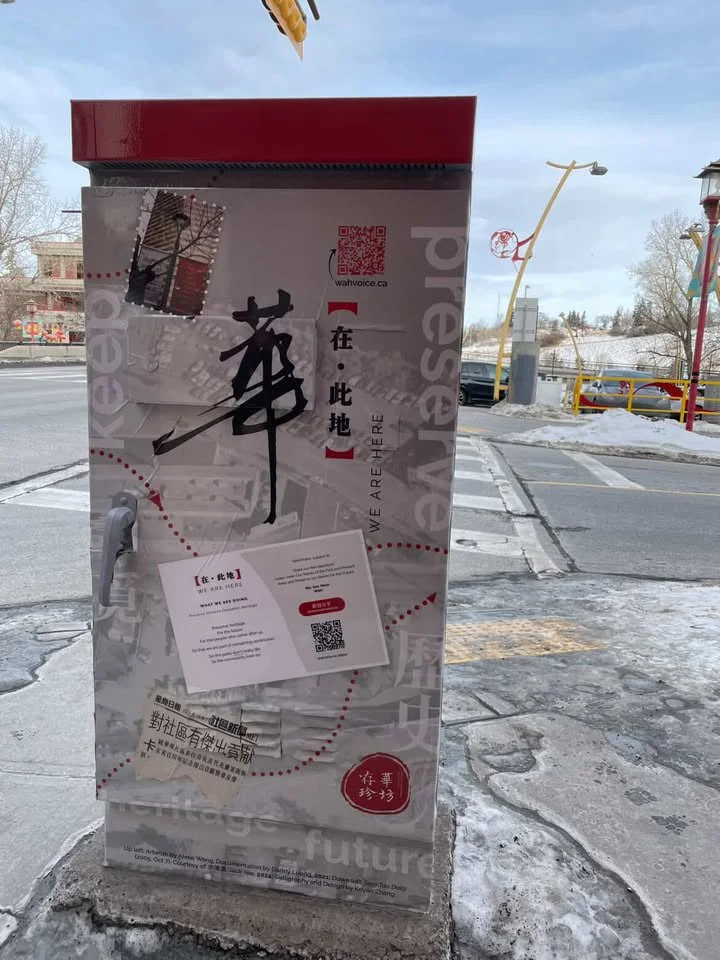
New artwork on Utility box Panel A shares an image of the banner, along a dotted path that is the very long journey that we the community continue to navigate.
We. Are. Here.
to address ERASURE, to dress the wounds.
So that we don’t forget. So time does not forget.
The path includes a postcard to ourselves on that journey to advocate heritage preservation.
Lower left image: In October 2005 Sing Tao Daily Chinse-language newspaper publishes article about outstanding Albertans from the Calgary Chinese community who had made a significant contribution to society. They were recognised and honoured with the Alberta Centennial Medal and Certificate in 2005. For the record, nineteen community members were presented with the award.
Lower right image: A custom-design 圖章 chop or seal adds a further artistic dimension as you scroll/stroll down the path, "sealing" the document or artwork, a traditional practice in Chinese art forms.
It would be impossible to say everything about addressing erasure, using only four words, but I tried. The four-word idiom 華坊存珍 was carefully crafted to convey layers of meaning. As a tone language, play on written words with same Cantonese tones helps to deliver the nuances. While 華坊存珍 sounds exactly the same as 華坊存真 華坊傳珍 華坊傳真 when spoken, they are four different phrases formed by distinct words; the only commonality is 華坊 “Wah [Chinese] Community.”
The chop 華坊存珍 = Wah Community Preserve Precious Things
華坊存真 = Wah Community Preserve Truth
華坊傳真 = Wah Community pass on/hand down Truth
華坊傳珍 = Wah Community pass on/hand down Precious Things
All four phrases are homophones, voiced in one chop using only four characters.
The backdrop of panel A is a historical aerial view of Calgary's Chinatown. Forefront, WAH 華 created in original ink brush calligraphy, is the character for “Chinese,” again with various meanings. “WE ARE HERE”【在 • 此地】are staking a claim to “reclaim the narrative.”
In addition, the background has the words:
Keep preserve future heritage
尋覓 search/seek as on a quest
歷史 history
All the visuals, words and expressions used throughout involved great care and long reflection. The process interlocks thoughts, reinforces narratives and history into chainmail to protect heritage and resist hate.
Upper right: WAHVoice QR code is provided for visitors who wish to explore more. Lots and lots happened along that dotted path between the images and postcard.
Utility box Panel B
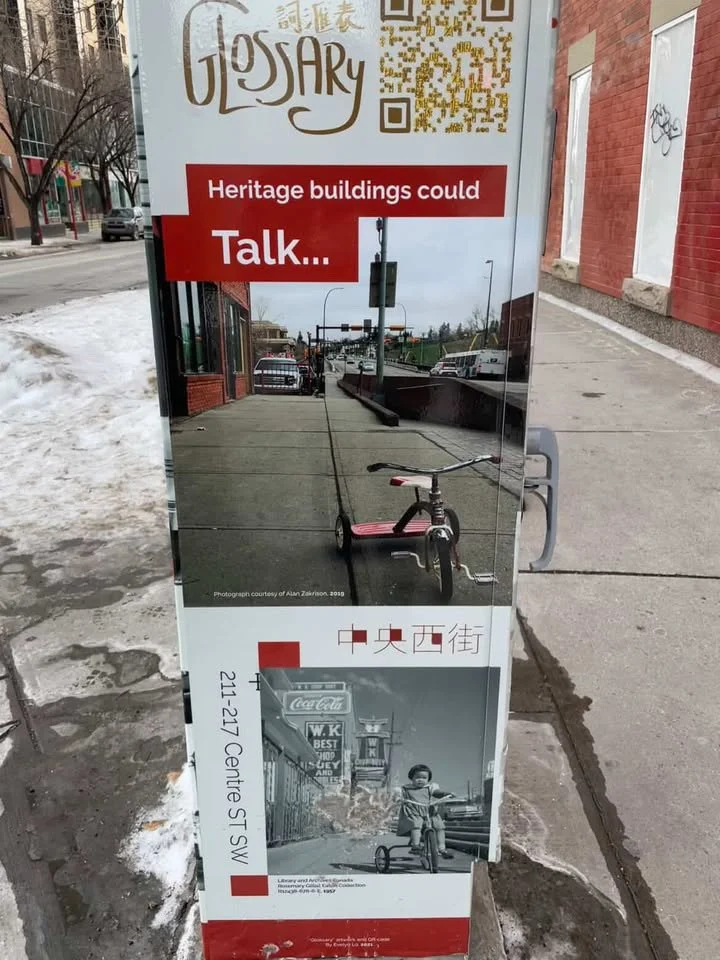
Top image: Riderless tricycle. Where have all the children gone? Throughout history, Chinatown communities have been displaced and citizens erased. But “Heritage buildings could Talk.” Canton Block along the east side of Centre Street is one such row of heritage buildings—they remember.
Bottom image: little girl riding a tricycle in front of her home. The street address no longer exists, nor does the row house where she lived in 1957. The last residential houses in Chinatown were demolished in the 1970s, families displaced.
Based on the age of the two small children in the historical photograph, they were most likely born here some years after the Chinese Exclusion Act was repealed, when families were allowed to enter Canada to be reunited. The two children would be representative of the first wave of Canadian-born Chinese after the repeal of The Act.
Upper right: “Glossary” artwork and QR code
Take a real close look at the Glossary QR Code—the code is hand-crafted with Han characters in miniature, not just made with the click of a button. Of course, you would simply scan the code the same way with your phone.
The “Code” showcases a myriad of Canto expressions (and a few Toisan/Hoisan, and Chinglish) from different generations: from golden oldies to the latest urban speak. Artwork travels through time with the use of Canto and Toisan/Hoisan, heritage languages of Chinatowns throughout this continent—languages heard by and in the heritage buildings.
Lots of hidden gems through the QR code leading to this website https://evelyn244.wixsite.com/dhyc/cha; including a glossary with audio tracks to learn Canto, and music or video links that provide context for each phrase, weaving sights and sounds, dimensions that complement and augment the artwork.
Utility box Panel C
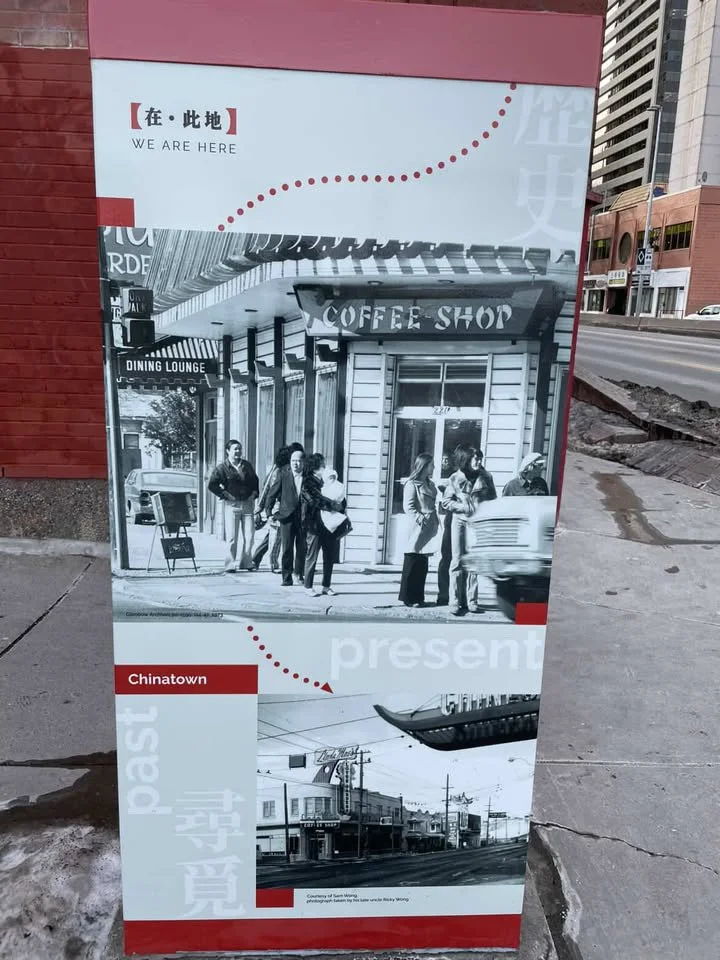
Iconic, historical images of Linda Mae’s Coffee Shop that was situated at the corner of 3rd Avenue and Centre Street SW, with the W.K. Chop Suey Restaurant seen further north.
Utility box Panel D
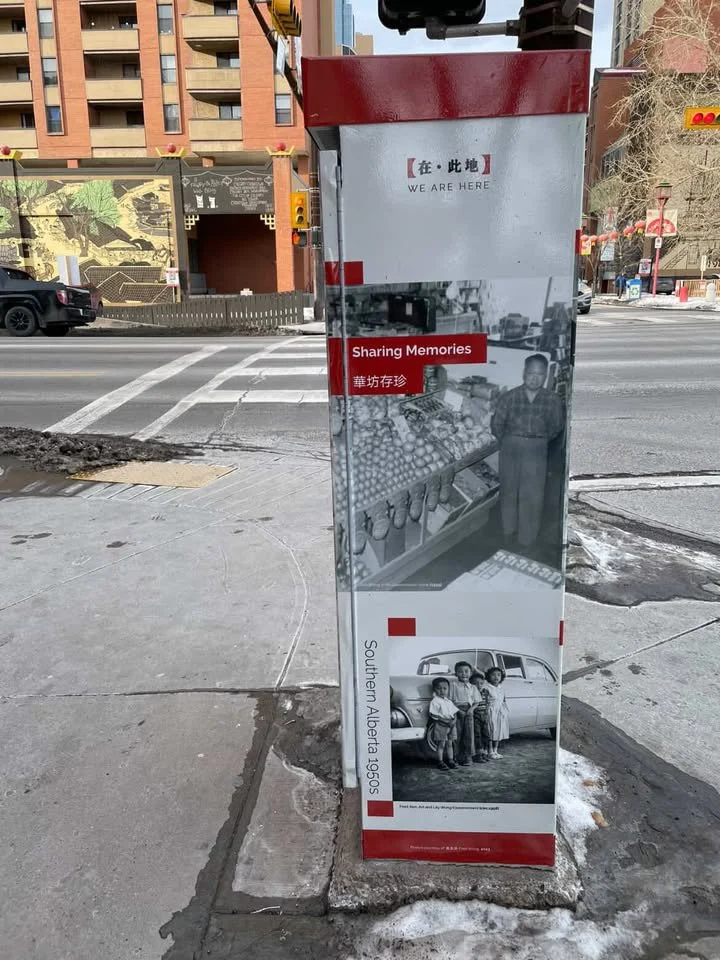
Historical images of family patriarch Dan Wong in his Queenstown store, 1959; his children Fred, Ken, Art and Lily Wong, in Queenstown, Southern Alberta, circa 1958.
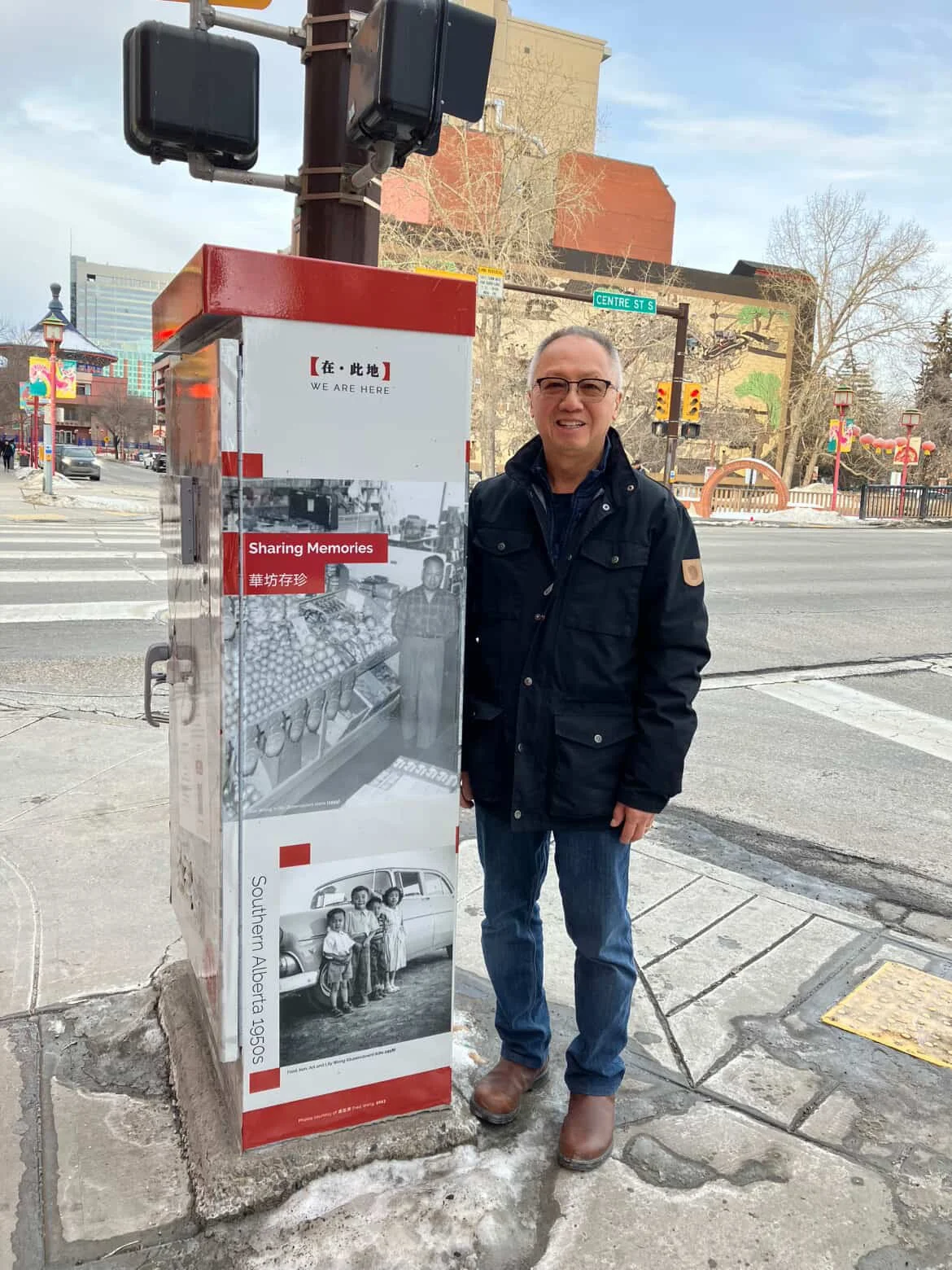
Fred Wong is seen standing next to his childhood pic with siblings in front of car. Both his brother (now in his 90s) and father were very active members of the Wong Association which is located only a block away from the utility box.